 jooootv
Streaming jargon, explained simply: from APK to HDR
Tech guides are full of jargon and abbreviations. This list explains the common ones in a sentence or two, roughly in order: apps first, then picture, then networks, then devices.
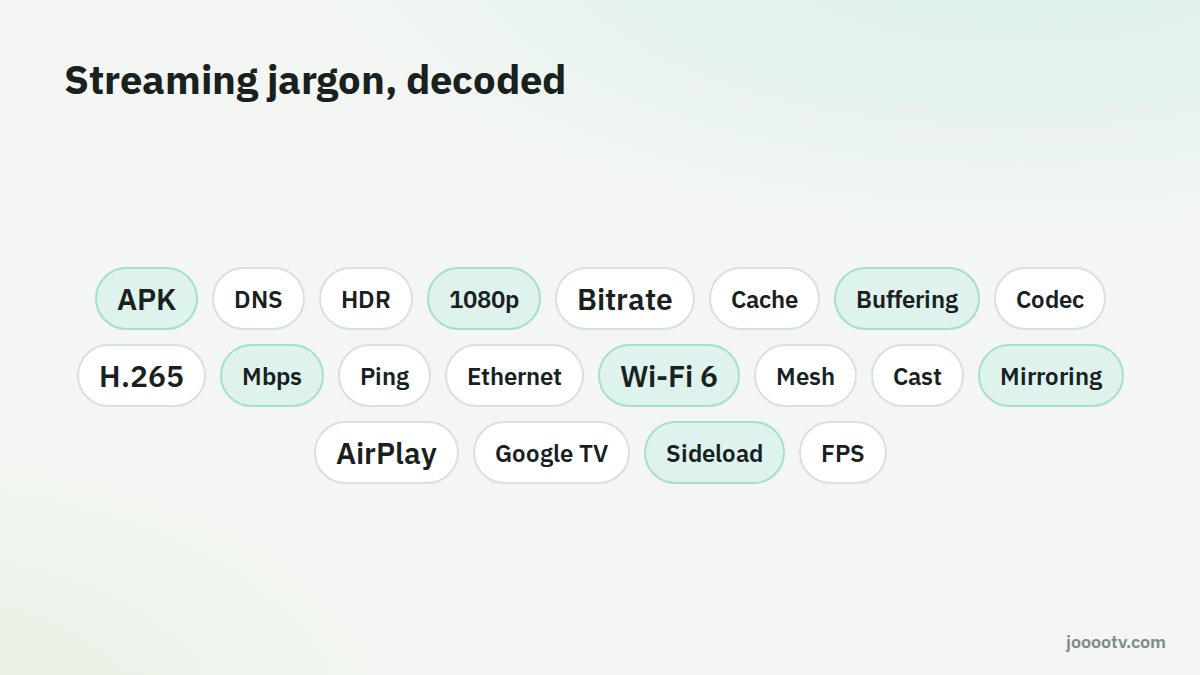
- APK
- The file format for Android apps. When you install an app from outside Google Play, you're installing an APK.
- Sideloading
- Installing an app from outside a device's official store, like putting an APK on a TV or Fire Stick.
- Unknown sources
- An Android permission that lets a specific app, such as your browser or Downloader, install APK files.
- Play Protect
- Google's built-in protection that scans apps on Android devices, including ones installed from outside the store.
- Resolution
- How many dots make up the picture: 480p is standard, 720p is HD, 1080p is Full HD, and 2160p is 4K.
- Bitrate
- How much data each second of video carries. Higher means a cleaner picture, and a faster connection needed.
- Frames per second (FPS)
- How many pictures are shown each second. Dramas are usually 24, 25 or 30; sport is often 50 or 60.
- HDR
- Widens the gap between the brightest and darkest parts of the picture and gives richer colour. Needs a TV that supports it and content made for it.
- Codec
- The way video is compressed. H.264 is everywhere; H.265 (HEVC) is newer and gives the same quality at a smaller size, but needs a device that supports it.
- Buffering
- That spinning circle while the player waits for more data. If it keeps happening, your connection is slower than the quality you've chosen.
- Cache
- Temporary files an app or browser keeps to open faster. Clearing it is safe and fixes a lot of problems.
- Megabits vs megabytes
- Internet speed is measured in megabits per second (Mbps); files in megabytes (MB). One megabyte is 8 megabits.
- Ping
- How long a signal takes to reach a server and come back. Matters more for gaming and calls than for watching video.
- DNS
- The internet's address book, turning a site's name into a numeric address. Changing it can fix sites that won't open, but rarely speeds up video.
- Router
- The box that shares your internet around the house over Wi-Fi and cables.
- Ethernet
- A network cable. More stable than Wi-Fi because walls and interference don't affect it.
- Wi-Fi 5 and Wi-Fi 6
- Wi-Fi generations. Wi-Fi 5 is 802.11ac; Wi-Fi 6 is 802.11ax, faster and better in homes full of devices.
- Mesh
- A Wi-Fi system of several units working as one network to cover the whole house.
- Casting
- Sending a video from your phone to the TV so the TV plays it straight from the internet and your phone acts as the remote.
- Mirroring
- Copying everything on your phone screen to the TV as-is. Heavier than casting and harder on the battery.
- AirPlay
- Apple's way of sending picture and sound from an iPhone, iPad or Mac to an Apple TV or a compatible TV.
- Android TV and Google TV
- Google's system for TVs and its newer interface. Both can install apps from APK files.
- Launcher
- The main screen you see when you switch on a TV or TV box, showing your apps and suggestions.
- Home screen web app
- A shortcut to a website on your iPhone or Android home screen that opens full screen like an app.
Looking for a term that isn't here? Send it over and we'll add it.
Ready? This button always opens the watch site at its current address.
Open the watch site